
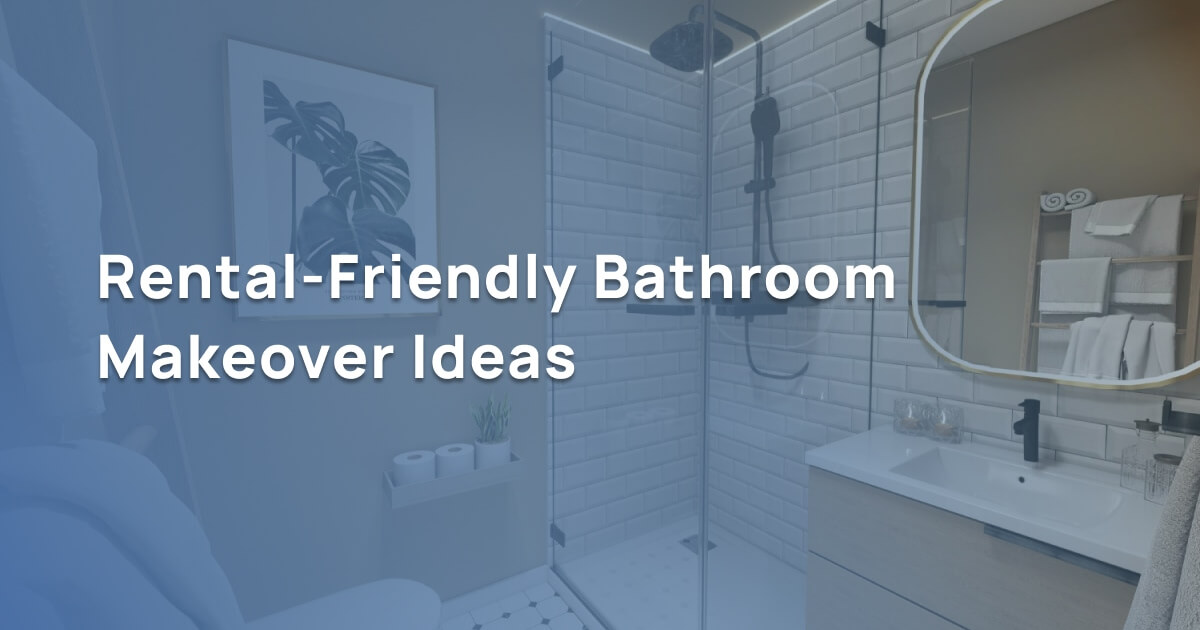
The first apartment I ever rented had a bathroom that could best be described as “early 2000s motel.” Beige tile, a single bulb dangling from a boob light fixture, and a mirror that somehow made everyone look slightly seasick. I wanted to gut it. My lease said otherwise. That tension, wanting a bathroom that feels like yours while a landlord wants the walls back exactly as they were, is the whole reason rental-friendly bathroom makeover ideas exist as a category in the first place.
With roughly 102.7 million Americans currently renting their homes, according to Census data compiled by Apartment List’s research team, this isn’t a niche problem. It’s the daily reality for nearly a third of the country, and the bathroom is usually the room people complain about most because it’s small, builder-grade, and the hardest to fake your way around.
The good news is that a rental bathroom doesn’t have to look like it belongs to your landlord. With a handful of reversible swaps, smarter lighting, and a few hardware changes you can undo in twenty minutes, you can make the space feel intentional and entirely yours, all without touching a single thing your landlord would notice on move-out day.
What Actually Makes a Bathroom Upgrade “Rental-Friendly”?
A rental-friendly upgrade is one that improves the room and disappears completely when you move out, leaving no holes, no stains, and no voided security deposit. That distinction matters more than people think. A Rent.com survey of 1,000 renters found that 26 percent had lost some or all of their security deposit at some point, and unauthorized paint or wall damage shows up again and again as one of the top reasons landlords cite. So before grabbing a paintbrush or a drill, it’s worth asking whether a change can come off in under an hour with nothing but a hair dryer and a little patience.
That’s the filter for everything in this guide. Peel-and-stick instead of permanent tile. Tension rods instead of drilled curtain rails. Adhesive hooks rated for the actual weight you’re hanging, not just whatever was sitting in the clearance bin. None of it requires landlord sign-off, and all of it comes down clean. If your lease has a specific clause about modifications, a quick message to your property manager before you start, in writing, so there’s a record, usually saves you the awkward conversation later. Most landlords genuinely don’t care what you do as long as the unit returns to its original state.
Rental-Friendly Bathroom Makeover Ideas on a Budget
Renters tend to assume a “makeover” requires hundreds of dollars and a free weekend they don’t have. It doesn’t. A real, visible rental bathroom refresh can happen across three budget tiers, and the jump in impact between them is bigger than the jump in price.
Under $50 covers a new shower curtain and liner, a bath mat that doesn’t look like it came free with a gym membership, a couple of small potted plants that tolerate humidity (pothos and snake plants both hold up fine), and swapping the harsh white vanity bulb for a warmer one.
Around $150 adds a peel-and-stick accent on one wall or behind the toilet, a clip-on framed mirror kit, new cabinet hardware, and a tension-rod shelf or ladder rack for towels.
At $300 and up, you can layer in all of the above plus a peel-and-stick floor application over existing vinyl (fully reversible, and genuinely convincing from a few feet away), a plug-in sconce or two for layered lighting, and a real storage cart to replace whatever flimsy shelf the unit came with.
The number itself isn’t the point. Rental-friendly bathroom makeover ideas on a budget work because they prioritize a few high-impact changes instead of trying to fix everything at once. Lighting and one bold surface change usually do more visual work than five small accessories combined.
Lighting Tricks That Make the Whole Room Feel Different
Swap the bulb before you swap anything else. Most builder-grade bathroom fixtures ship with a cold, bluish bulb that makes skin look tired and tile look clinical. Lighting professionals generally recommend a color temperature between 3000K and 4000K with a Color Rendering Index, or CRI, of 90 or higher for vanity areas, since that range renders skin tones accurately for makeup and grooming while still feeling warm enough for a relaxing space. It’s a five-dollar fix that changes the entire mood of the room, and the original bulb slides right back in before your final walkthrough.
If your fixture allows it, a plug-in wall sconce on either side of the mirror creates the kind of even, shadow-free light you’d find in a hotel bathroom, and it needs nothing more permanent than an outlet. For bathrooms with no outlet near the mirror, a battery-powered LED light bar with adhesive mounting tape does nearly the same job. Under-cabinet LED strips, the kind sold for kitchens, work just as well tucked along the underside of a vanity or a floating shelf, and they peel off without a trace.
Reversible Ideas to Overhaul Your Rental Bathroom Walls and Floors
Peel-and-stick products have gotten dramatically better over the past few years, both in how realistic they look and in how cleanly they remove. The trick is knowing where they hold up and where they quietly fail.
Vinyl tile sheets and individual peel-and-stick tiles work best on a wall behind the toilet, around a tub surround, or as a small backsplash strip behind a pedestal sink. Anywhere that gets direct, prolonged water exposure, inside an actual shower stall, for example, is a poor candidate, since the adhesive eventually lifts in high humidity. Removable wallpaper behaves the same way: great on a dry accent wall, risky right next to a running shower.
Where peel-and-stick flooring actually holds up
For floors, peel-and-stick vinyl tiles laid directly over existing tile or vinyl can convincingly mimic marble, hex tile, or patterned cement tile for a fraction of the cost of the real material. Cut a paper template first, lay the tiles without removing the backing to check the pattern, then commit. When you move out, a hair dryer on low heat softens the adhesive enough to lift each piece cleanly, usually without damaging the surface underneath, though it’s smart to test a hidden section first.
Mirrors Are the Cheapest Way to Make a Small Bathroom Feel Bigger
Interior designers have leaned on this trick for decades because it works on a physical level: a mirror doubles the amount of visible light and depth in a room, exactly what a windowless rental bathroom needs most. A full-length mirror leaned against the wall, not mounted, instantly makes a cramped bathroom feel less like a closet, and it travels with you on moving day.
If your existing mirror is the plain, edge-to-edge builder type, a peel-and-stick mirror frame kit, originally designed for resale-focused upgrades, dresses it up without removing the mirror itself or touching the wall behind it. A round mirror hung with adhesive strips rated for its weight adds visual softness against all the hard right angles a typical bathroom has. Just check the strip’s weight rating against the mirror’s actual weight; this is one spot worth spending a few extra dollars on a sturdier mount instead of risking a cracked mirror on the floor.
Texture, Curtains, and the Soft Stuff That Makes a Bathroom Feel Finished
A bathroom built entirely from hard surfaces, tile, porcelain, laminate, reads as cold no matter how good the lighting is. Layering in texture is one of the most underused rental-friendly tips on decorating bathrooms, mostly because people don’t think of a bathroom as a place for textiles beyond a towel.
A waffle-weave or linen-look shower curtain does more for the room’s perceived quality than almost anything else on this list, and it usually costs less than the peel-and-stick options. Hang it a few inches above the standard height; the extra vertical space makes ceilings feel taller. A second layer, like a small woven curtain hung over an awkward window with a tension rod, hides ugly blinds without a single screw. Bath mats in a chunky, textured weave instead of flat bath rugs add the same softening effect underfoot. None of it is permanent, and all of it fits into a single box on moving day.
Hardware Swaps That Look Like a Real Renovation
Cabinet pulls and knobs are one of the highest-leverage changes in this entire guide because builder-grade hardware is almost always cheap, generic, and instantly recognizable. Swapping it for matte black, brushed brass, or unlacquered brass pulls takes about twenty minutes with a screwdriver, and the original hardware goes into a labeled bag in a drawer until move-out, when it goes right back on.
A faucet aerator swap or a slip-on faucet sleeve changes the finish of a sink faucet without any plumbing work. Towel bars are trickier since most are screwed into the wall, but a tension-mounted towel bar or an over-the-door rack delivers the same function without the holes. Even a drawer liner swap, something most renters skip entirely, makes the inside of a vanity cabinet feel considered instead of neglected.
Furniture Arrangement Tricks for Tiny Rental Bathrooms
Most rental bathrooms are small enough that “furniture arrangement” sounds like a stretch, but even a five-by-eight footprint has more layout flexibility than people use. A slim rolling cart tucked beside the toilet or vanity adds storage without blocking the door swing, and it rolls out of the way during cleaning. An over-the-toilet etagere uses the one chunk of vertical space almost every bathroom wastes.
If there’s a corner with no fixture, a narrow ladder shelf leaned against the wall, again leaned, not mounted, holds rolled towels and draws the eye upward, which makes the ceiling feel higher than it actually is. The design principle at work here, sometimes called visual weight distribution, is that a room with one tall element and a few low ones feels more balanced than a room where everything sits at the same height. It’s the same logic stylists use when arranging a bookshelf.
Organization Makes Renter-Friendly Bathroom Decor Actually Stick
Decor only reads as intentional if the room underneath it is organized, and clutter undoes lighting, mirrors, and hardware swaps faster than anything else. A widely cited UCLA study from the university’s Center on Everyday Lives of Families found a measurable link between a high density of visible household objects and elevated cortisol, the body’s primary stress hormone, particularly among women. A cluttered counter doesn’t just look messy. It’s measurably stressful to be around.
Clear acrylic or woven bins on open shelving contain the visual chaos while staying accessible, and labeling them, a five-minute task, makes the system actually stick instead of collapsing within a week. A drawer organizer for the vanity, a tension-mounted shelf inside the shower for bottles instead of a tray balanced on the tub edge, and a small adhesive wall caddy for hair tools all reduce the amount of stuff sitting in plain sight. The goal isn’t minimalism for its own sake. It’s making sure the decor choices you actually made are the things people notice first.
Scent and the Small Final Touches
Smell shapes how a room feels almost as much as how it looks, and it’s the cheapest category on this entire list. A reed diffuser or a battery-operated essential oil diffuser handles the humidity smell most bathrooms develop, and unlike candles, neither requires an open flame near a space full of towels and aerosols. A small live plant, or even a convincing fake one if your bathroom gets zero natural light, softens the hard edges of tile and porcelain in a way almost nothing else does for the price.
Key Takeaways
Start with lighting and one bold, reversible surface change, since those two moves carry the most visual weight for the least money. Keep every modification removable: peel-and-stick over tile, tension rods over drilled rails, adhesive strips over screws. Save the original hardware and bulbs in a labeled bag so move-out day takes ten minutes instead of an afternoon. And don’t skip organization. A styled bathroom with visible clutter still reads as messy, no matter how good the mirror or lighting looks.
Rental-friendly bathroom makeover ideas work because they solve the actual problem renters face: wanting a space that feels finished without the risk of losing money or violating a lease. None of the changes above need a landlord’s permission, a contractor, or a weekend you don’t have. Pick two or three from this list, start with whichever feels most doable this weekend, and build from there. A bathroom that looks intentional doesn’t require ownership. It just requires the right reversible choices.
Frequently Asked Questions
Will decorating my rental bathroom void my security deposit?
Reversible changes, peel-and-stick materials, tension rods, and adhesive hooks rated for the weight you’re hanging generally won’t affect your deposit as long as they come down cleanly and original fixtures go back before move-out. Permanent changes like paint, drilled holes, or new tile almost always require landlord approval first.
Does peel-and-stick wallpaper or tile damage the wall underneath when removed?
Most modern peel-and-stick products are designed to release cleanly from painted drywall and tile when removed slowly and, if needed, warmed slightly with a hair dryer. Always test a small, hidden section first, since paint quality and wall texture vary between units.
What’s a realistic budget for a rental-friendly bathroom makeover?
A noticeable refresh can happen for under $50 with a new shower curtain, bath mat, and bulb swap. A more complete makeover, including a peel-and-stick accent wall and new hardware, typically lands between $150 and $300.
How do I make a small rental bathroom feel bigger without renovating?
A leaning full-length mirror, a curtain hung higher than the rod’s default height, and a single tall furniture piece like a ladder shelf all create the illusion of more space without any construction.
Can I paint a rental bathroom?
Only with written permission from your landlord. Many leases specifically restrict wall color changes, and unauthorized paint remains one of the most common reasons renters lose part of their security deposit.
